
Free VPN vs Paid VPN: What You're Actually Trading Away
August 17, 2026 · 5 min read
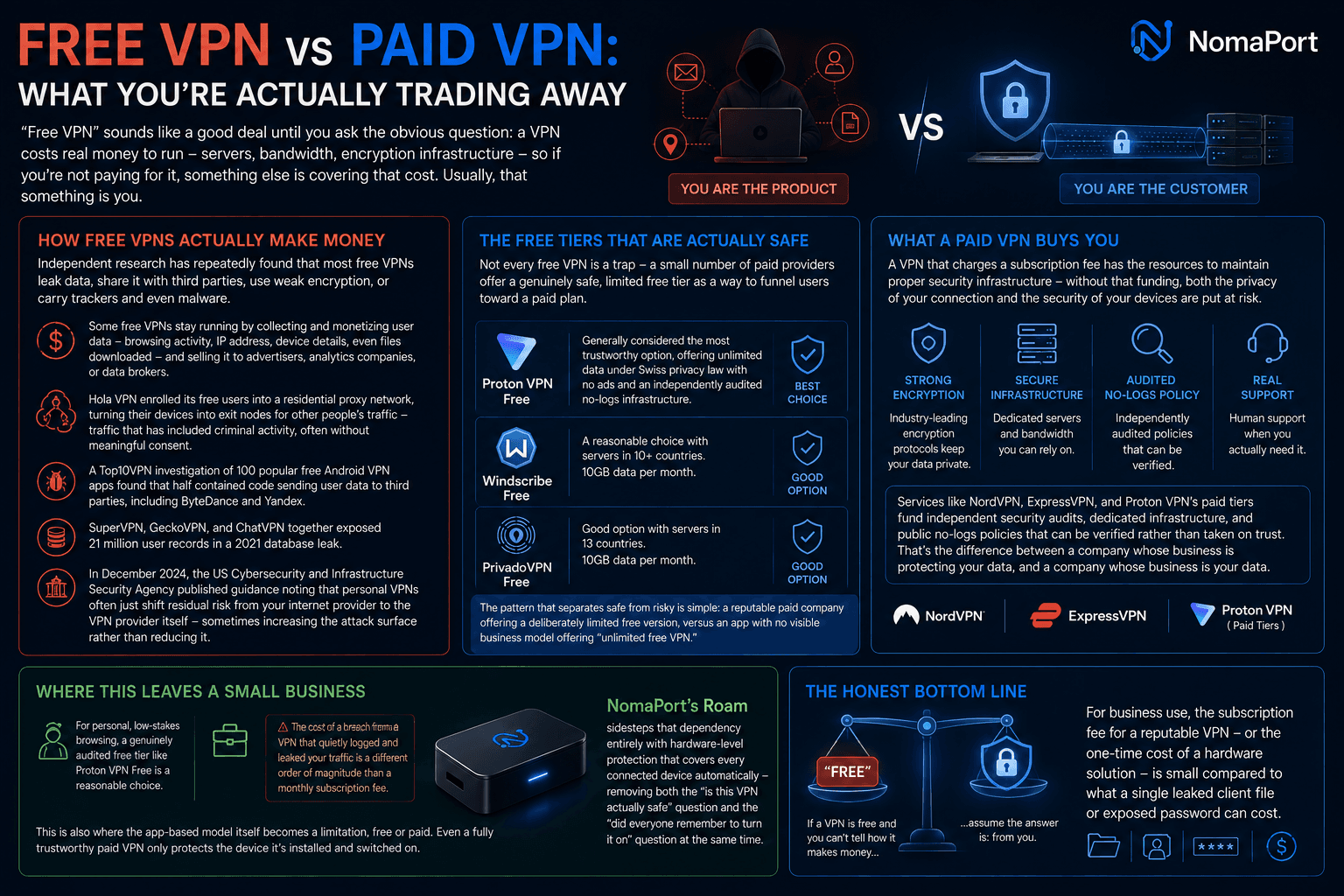
"Free VPN" sounds like a good deal until you ask the obvious question: a VPN costs real money to run - servers, bandwidth, encryption infrastructure - so if you're not paying for it, something else is covering that cost. Usually, that something is you.
How free VPNs actually make money
Independent research has repeatedly found that most free VPNs leak data, share it with third parties, use weak encryption, or carry trackers and even malware. The business model explains why: some free VPNs stay running by collecting and monetizing user data - browsing activity, IP address, device details, even files downloaded - and selling it to advertisers, analytics companies, or data brokers.
A few documented cases show how far this goes. Hola VPN enrolled its free users into a residential proxy network, turning their devices into exit nodes for other people's traffic, traffic that has included criminal activity, often without meaningful consent. A Top10VPN investigation of 100 popular free Android VPN apps found that half contained code sending user data to third parties, including ByteDance and Yandex. SuperVPN, GeckoVPN, and ChatVPN together exposed 21 million user records in a 2021 database leak.
In December 2024, the US Cybersecurity and Infrastructure Security Agency published guidance noting that personal VPNs often just shift residual risk from your internet provider to the VPN provider itself, sometimes increasing the attack surface rather than reducing it. That warning is aimed squarely at the crowded field of unverified free apps, not at every VPN on the market.
The free tiers that are actually safe
Not every free VPN is a trap - a small number of paid providers offer a genuinely safe, limited free tier as a way to funnel users toward a paid plan. Proton VPN Free is generally considered the most trustworthy option, offering unlimited data under Swiss privacy law with no ads and an independently audited no-logs infrastructure. Windscribe Free and PrivadoVPN Free are also reasonable choices, though both cap monthly data around 10GB.
The pattern that separates safe from risky is simple: a reputable paid company offering a deliberately limited free version, versus an app with no visible business model offering "unlimited free VPN."
What a paid VPN buys you
A VPN that charges a subscription fee has the resources to maintain proper security infrastructure - without that funding, both the privacy of your connection and the security of your devices are put at risk. That's the real trade: paying for a VPN isn't paying for a premium version of the same protection, it's paying for the protection to actually exist as advertised.
Services like NordVPN, ExpressVPN, and Proton VPN's paid tiers fund independent security audits, dedicated infrastructure, and public no-logs policies that can be verified rather than taken on trust. That's the difference between a company whose business is protecting your data, and a company whose business is your data.
Where this leaves a small business
For personal, low-stakes browsing, a genuinely audited free tier like Proton VPN Free is a reasonable choice. For anything involving client files, financial records, or business communications, the calculation changes - the cost of a breach from a free VPN that quietly logged and leaked your traffic is a different order of magnitude than a monthly subscription fee.
This is also where the app-based model itself becomes a limitation, free or paid. Even a fully trustworthy paid VPN only protects the device it's installed and switched on. NomaPort's Roam sidesteps that dependency entirely with hardware-level protection that covers every connected device automatically, removing both the "is this VPN actually safe" question and the "did everyone remember to turn it on" question at the same time.
The honest bottom line
If a VPN is free and you can't tell how it makes money, assume the answer is: from you. For business use, the subscription fee for a reputable VPN - or the one-time cost of a hardware solution - is small compared to what a single leaked client file or exposed password can cost.