
VPN vs Proxy: What's the Difference, and Why It Matters for Your Business
August 17, 2026 · 5 min read
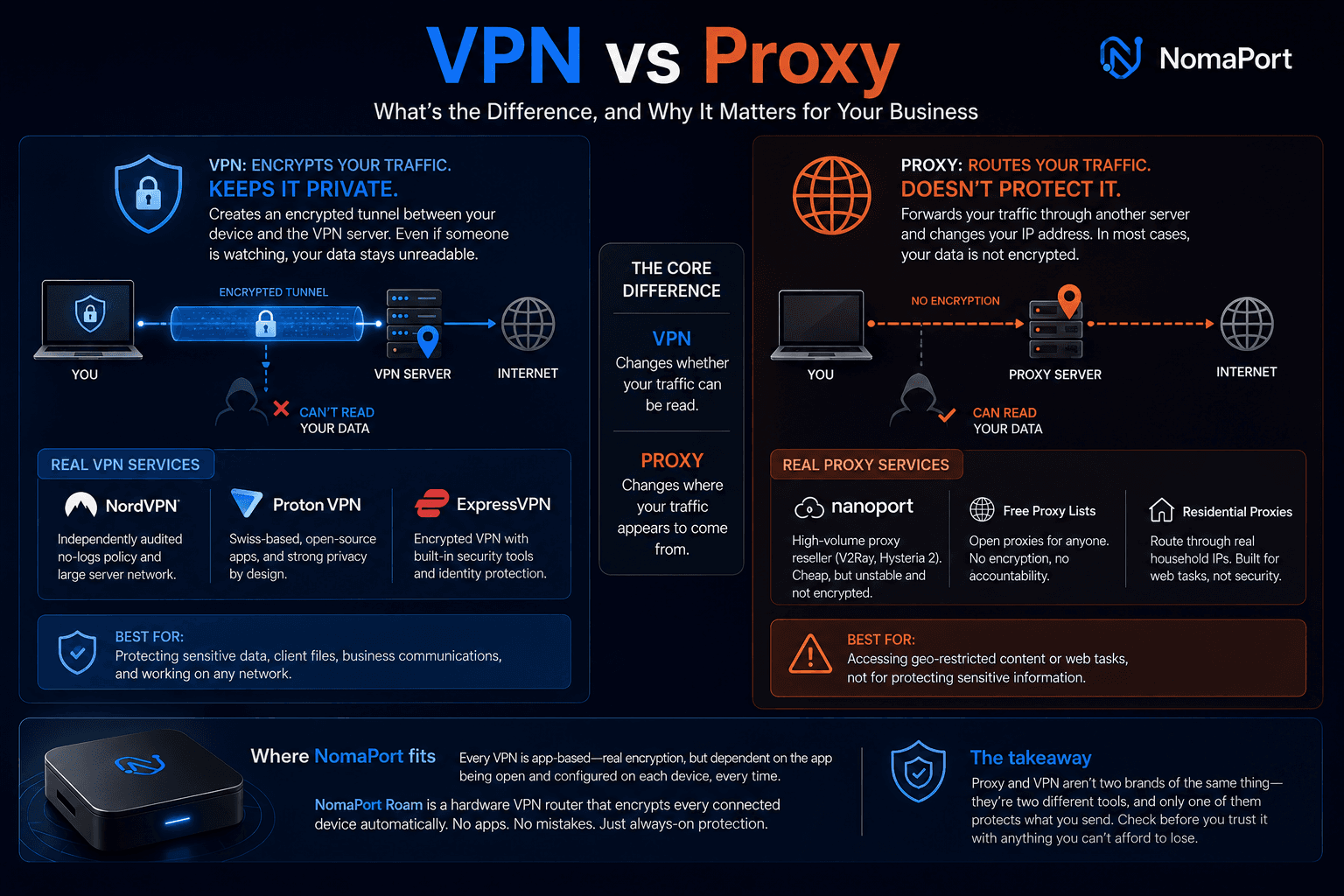
"VPN" and "proxy" get used interchangeably in casual conversation, and that mix-up causes real problems - people choose a proxy service expecting VPN-level protection, and find out the difference only after something goes wrong. Here's what actually separates the two, with real examples of each.
The core difference
A proxy sits between your device and the internet and forwards your traffic through its own IP address. That's it. It changes what website you appear to be connecting from - useful for getting around a geographic restriction or a content block - but in most cases it does not encrypt your traffic. Anyone monitoring the network you're on can often still see what you're sending.
A VPN does more: it creates an encrypted tunnel between your device and the VPN server, so even if someone is watching the network, what they see is scrambled, unreadable traffic. The IP-masking effect is similar to a proxy, but the encryption is the part that actually protects your data.
In short: a proxy changes where your traffic appears to come from. A VPN changes whether your traffic can be read at all.
Real VPN services
NordVPN - a full encrypted VPN with an independently audited no-logs policy and a large server network. Built for individuals and, on business plans, for teams.
Proton VPN - a Switzerland-based encrypted VPN known for open-source, independently verifiable apps and jurisdiction outside major intelligence-sharing alliances.
ExpressVPN - an encrypted VPN that has expanded into a broader security suite, including identity protection tools alongside the core VPN.
All three encrypt your traffic end to end. The tradeoff, as covered in our earlier comparison, is that protection depends on the app being open and configured correctly on every device.
Real proxy services
Nanoport - a Chinese "jichang" (proxy reseller) offering high-volume data packages at very low prices, supporting protocols like V2Ray and Hysteria 2, with nodes in Hong Kong, Japan, Taiwan, Singapore, and the US. It's built around tunnelling traffic through, not encrypting it end-to-end the way a VPN does, and user reports commonly cite connection instability at that price point. Services like this are a useful illustration of what a proxy actually is: cheap, high-volume IP routing, without the security guarantees people assume come with the word "VPN."
Free public proxy lists - websites that publish open SOCKS5 or HTTP proxy addresses anyone can use. No encryption, no accountability for who's running the server, and no way to know who else has access to your traffic while it passes through.
Residential proxy networks - services that route traffic through real household IP addresses, often used for web scraping or ad verification rather than personal security. Built for looking like ordinary traffic, not for protecting it.
Where the confusion causes real problems
Someone comparing prices sees a proxy offering huge data volumes for a few dollars a month, next to a VPN charging more for a fraction of the traffic, and assumes they're the same category of product with different pricing. They're not. A proxy can hide your location. It generally can't stop someone on the same network from reading what you send, which matters a great deal if that "someone" is on hotel Wi-Fi, an airport network, or a shared office connection.
For personal browsing or getting around a regional content block, a proxy is often good enough. For anything involving client files, financial data, or business communications, the encryption a VPN provides isn't optional.
Where NomaPort fits
Every VPN listed above is app-based - real encryption, but dependent on the app being open and correctly configured on each device, every time. NomaPort's Roam takes the VPN side of this comparison and removes that dependency: a hardware router that encrypts every connected device automatically, without an app to remember to open. It's built for the businesses that need what a VPN provides, without needing to think about it constantly.
The takeaway
Proxy and VPN aren't two brands of the same thing - they're two different tools, and only one of them protects what you send. If a service is advertising huge data allowances at almost no cost, it's very likely a proxy, not a VPN, and it's worth checking before you trust it with anything you can't afford to lose.